What we learned from a study on climate change and earth’s groundwater depletion.
Nonprofit, investigative journalism on a mission to hold the powerful to account. Donate

ProPublica
ProPublica

Dispatches

November 19, 2026 · View in browser

In today’s Dispatches: Abrahm Lustgarten breaks down what you need to know about a new study on our rapidly drying planet

You may not feel it, but the ground beneath you may be sinking. In fact, the surface of California’s Central Valley is nearly 30 vertical feet lower than it was a century ago. Why is this happening? Because our planet is rapidly drying. 

As the climate warms, reservoirs are shrinking and glaciers are melting. 

Abrahm Lustgarten, ProPublica editor

As water gets more scarce, people are increasingly drilling into a largely ungoverned cache of fresh water underground. Our sinking ground is actually a foolproof sign of this supply disappearing. Think of a drying sponge: As groundwater is pumped out, the earth above collapses as the ground compresses. From Spain to China to here in the U.S., places around the world are seeing the effects.


Globally, 70% of fresh water is used for growing crops, with more of it coming from groundwater as droughts become more extreme. But only a small amount of that water makes its way back into aquifers.

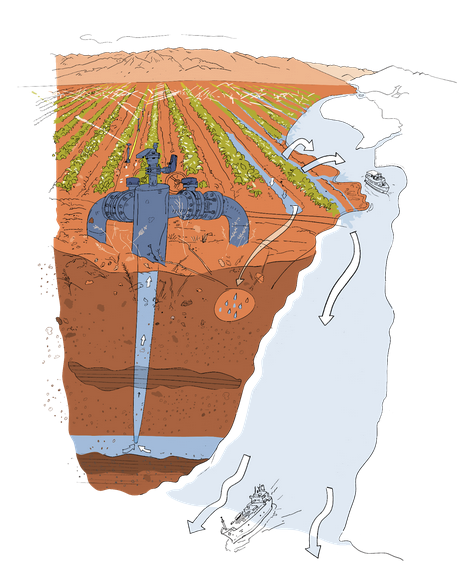
An illustration of how groundwater is pumped and runs off the land into streams.

Instead, most of the water runs off the land into streams, eventually flowing from rivers into the ocean. Fresh water becomes salt water — and for that water to become usable again, it has to be treated or return to the land as rain.


It’s a vicious cycle: Pumping for groundwater is dehydrating our world at the very moment global temperatures are soaring past records. And yet, people take more water from underground due to need, when climate-driven heat and drought are at their worst.


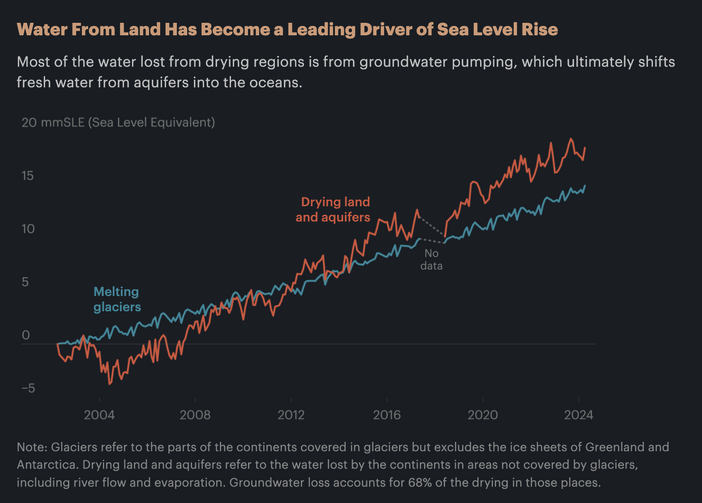
It’s not just about losing usable water, either. According to a new study published in the journal Science Advances based on 20+ years of NASA data, runoff from pumped groundwater, combined with moisture lost to evaporation and drought, is now one of the largest contributors of sea level rise.


A chart showing how water from land has become a leading driver of sea level rise.


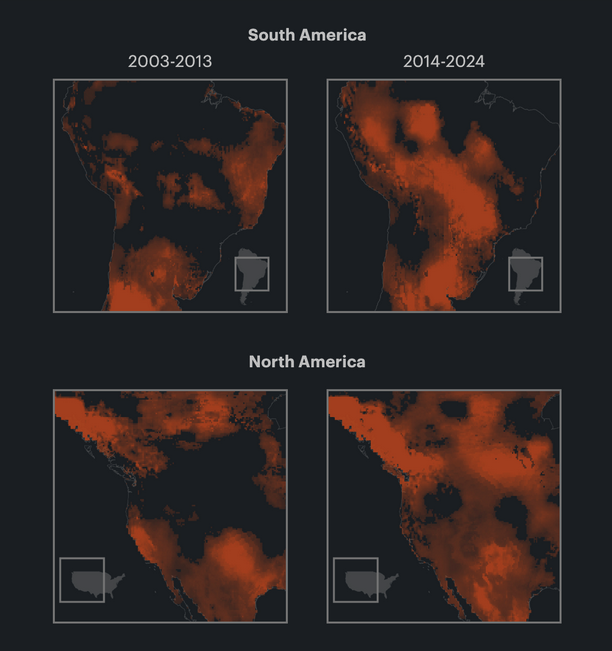
People aren’t just misusing groundwater, they are flooding their own coasts and cities in the process, warned Jay Famiglietti, one of the study’s co-authors. Drying regions are also merging. One such “mega” region covers almost the whole of Europe, the Middle East, North Africa and parts of Asia. Just look at how much larger the dry regions in North and South America (in red) have become based on 2003-13 versus 2014-24 data.


A chart showing how water from land has become a leading driver of sea level rise.

All of this heralds “potentially staggering” and cascading risks for global order, the researchers write. Their findings point to the likelihood of widespread famine, the migration of large numbers of people seeking a more stable environment and geopolitical conflict. 


In Syria, beginning in 2011, drought and groundwater depletion drove rural unrest that contributed to the civil war. In Ghana, in 2017, protesters rioted as wells ran dry. And in Ukraine, water infrastructure has been a frequent target of Russian attacks.


Water pumped from aquifers is not easily replaced, if it can be at all. Many groundwater basins took millions of years to form and might take thousands of years to refill. But there are actions we can take, the study suggests, and they have to start now.


For instance, agriculture can use technologies like drip irrigation, which can cut use of ground water by as much as 50%. When California farms reduced their take of Colorado River water in 2023 and 2024, water levels in the nation’s largest reservoir jumped by 16 vertical feet. Aaron Salzberg, former director of the Water Institute at the University of North Carolina at Chapel Hill, believes a national water policy is key. Prioritizing the use of water resources for collective interest could counterbalance the forces of habit and special interests, he said.


Unless solutions are implemented, the future is uncertain. “We are already dipping from a trust fund,” the study’s lead author, Hrishikesh Chandanpurkar, said. “We don’t actually know how much the account has.”


The Drying Planet

Read story
 

More From Our Newsroom


Veterans’ Care at Risk Under Trump as Hundreds of Doctors and Nurses Reject Working at VA Hospitals

“We Want to Save This Investment”: Advocates Race to Secure Maternal Health Funding Before It Runs Out

How the Rapid Spread of Misinformation Pushed Oregon Lawmakers to Kill the State’s Wildfire Risk Map

The Man Running Israel’s Intelligence Operation

Israel Secretly Recruited Iranian Dissidents to Attack Their Country From Within


Find us on Facebook Find us on Facebook Threads Find us on Instagram Find us on Instagram Instagram Watch us on TikTok Watch us on TikTok TikTok Find us on X Find us on X (Twitter) Find us on Mastodon Find us on Mastodon Mastodon

Was this email forwarded to you from a friend? Subscribe.


This email was sent to ruthmarie.hicks@gmail.com.

 
Preferences Unsubscribe
 

ProPublica

155 Ave of the Americas, 13th Floor

New York, NY 10013