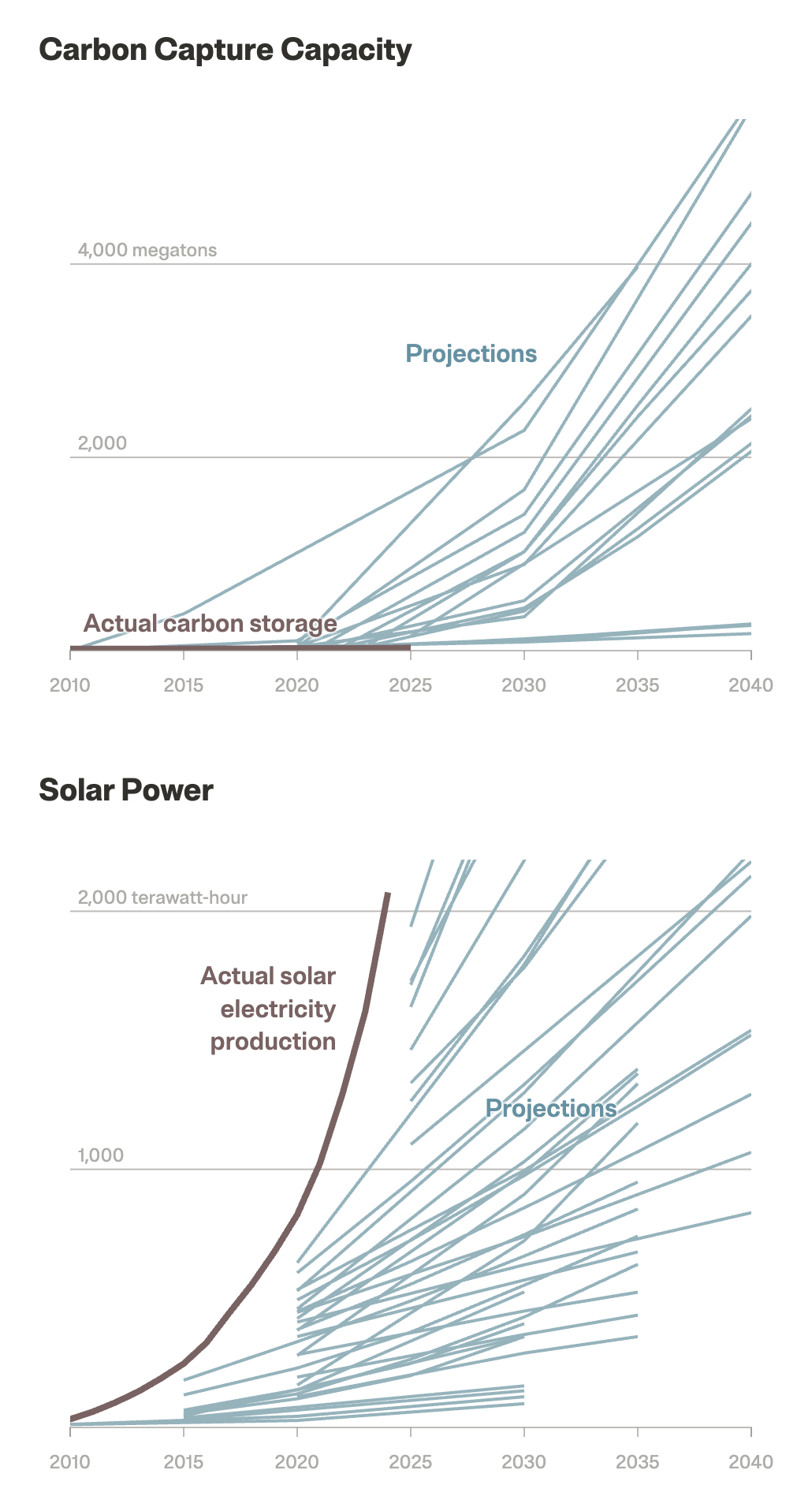
I wanted to understand what could possibly account for such a disparity. But the problem is the models are opaque: Unlike most scientists, who trade in public, peer-reviewed studies, modelers aren’t required to document every assumption they build into their influential simulations.
So I tracked down the leaders of the world’s three most influential climate models — one based in the Netherlands, another in Germany and a third in Austria — and asked. Here’s what I learned:
Climate models assume it’s easy and efficient to capture carbon. It’s not.
Public data is hard to come by, but several analyses have found the real capture rates are far lower than the industry has promised. Yet the models calculate as much as a 92% success rate. When I pointed out this discrepancy to Keywan Riahi, who leads the Austrian model, he insisted that capturing concentrated CO2 from industrial emissions “is not high-tech, this is very easy to do.” Riahi told me the models assume a high rate of capture because they factor in incentives such as payouts from carbon taxes and large government subsidies. Add those incentives, he argues, and the capture rates would increase.
They don’t account for problems that come up in real-world practice.
In project after project, operators have struggled to inject as much carbon into the earth as they say they can. For instance, at Chevron’s Gorgon natural gas processing plant in Australia, billed as the largest CCS operation on Earth, clogged wells and pressure spikes have forced operators to release most of their CO2 straight into the air. As it stands, only the German model, led by Jessica Strefler, assumed there’d be any limit to how much CO2 operators could inject underground at once. But, she told me, there is no good data to work from, and she pegged the limit based on “expert interviews” with people in the industry.
They assume the Earth is a bottomless geologic landfill. Modelers took that cue from a rosy 2005 U.N. report, which I’d learned had been written at the behest of Saudi Arabia and allied petrostates, that portrayed underground storage space as practically limitless. (The U.N.’s climate science body has said it stands by the report. Scientists who contributed to the report also defended their work. Authors and editors from Saudi Aramco, Chevron and Shell joined scientists in writing it; the companies did not respond to requests for comment.) Yet just last year, a paper in the journal Nature warned that the earth’s capacity to absorb CCS could be far more limited once you rule out pumping the gas beneath cities, into earthquake zones and under the deepest parts of the oceans. If CCS ever worked at the scale modelers imagine, the paper found, the Earth could run out of room as soon as early next century. Riahi, himself a co-author on that paper, conceded that although his model presumes the earth’s capacity for carbon storage is literally infinite, the real potential may be “smaller.”
They assume that stored CO2 will stay put.
Scientists warn that even tiny annual leak rates over longtime horizons could undermine a storage site’s climate benefit. Our investigation found two large-scale sites that have leaked, one all the way to the surface. Surely the models all factor in this risk? I asked Detlef van Vuuren, leader of the Dutch model, if his did so. His one-word answer: “Nope.”
The models all assume CCS gets more affordable over time, though real-world costs have steadily climbed. When I asked Strefler if it makes sense to assume our children and grandchildren will pay big bucks to suck CO2 out of the air, even though today governments won’t spend pennies to avoid emitting that pollution, she said: “If a country is not willing to do that, I don’t see how they would be willing to” pay for CO2 removal.
In short, the modelers overlooked decades of underperformance, inflated capture rates, evidence of leaks and finite underground storage, all while assuming future generations will willingly bankroll an increasingly expensive industry. They pointed to a mix of legitimate studies to support those assertions. They also pointed to unreviewed white papers, casual chats with industry insiders and the 2005 U.N. report — of which van Vuuren was an author. Van Vuuren said his team is working to revise some of its assumptions, but he generally sees no technical reason why CCS cannot work, or should be excluded from the possibilities his model considers. He said it is a policy decision whether countries wish to invest the dollars and effort to make it happen.
One way to look at the model projections is as recipes for the future. Seen this way, the modelers’ argument is that their job is to assemble a cookbook, not tell us how each recipe tastes. In other words, the models merely show that if CCS works and is used at an extraordinary scale, it is possible to hit climate targets. And the modelers told ProPublica and Drilled that the delay in climate action has left few other tools to do so — and so they include CCS.
A good recipe, though, cannot rely on imaginary ingredients. If we’re making unrealistic assumptions, why not include the possibility that aliens will appear and hand us a solution to climate change, I asked Riahi, half joking.
“You can quote me that I think carbon dioxide removal is more likely than an alien,” Riahi said.