So why didn’t this story drive more of a national conversation when it appeared?
As a news organization that tries to spur change by bringing new facts to light, we think about this question a lot. Our job at ProPublica is to both get the story and get it into the heads of a critical mass of citizens and elected officials.
I’ve been an investigative reporter and editor for nearly three decades, and I still struggle to predict which of our stories will catalyze national conversations. Our 2018 story about the recording of a young girl in a immigration detention center prompted the Trump administration to end its policy of family separation at the border. Many other powerful stories fail to break through.
Part of the problem, of course, is the proliferation of media. Every day, dozens of important-sounding stories vie for readers’ attention along with the flood of posts on social media and texts from friends and colleagues. And that’s not to mention all the podcasts and multipart dramas on Netflix and HBO.
This was an issue long before Trump and his allies adopted a “flood the zone” strategy with multiple norm-challenging actions, but it seems even more acute right now.
It is often said of journalists that we write the rough draft of history. But our work differs from historians in a crucial aspect: Scholars typically are chronicling events after the outcome is clear. As journalists, we face a tougher challenge as we try to find the stories in the cacophony of daily events that tell us something about where we’re going.
A lot of what we do as reporters is akin to squinting through opaque windows at events unfolding in a very dimly lit room. We can see who is inside and how they’re moving, but our lack of context often prevents us from understanding what’s really happening. We default to assuming that the future will be roughly like the past, guessing that, say, Trump 47 will be roughly like Trump 45 with fewer guardrails.
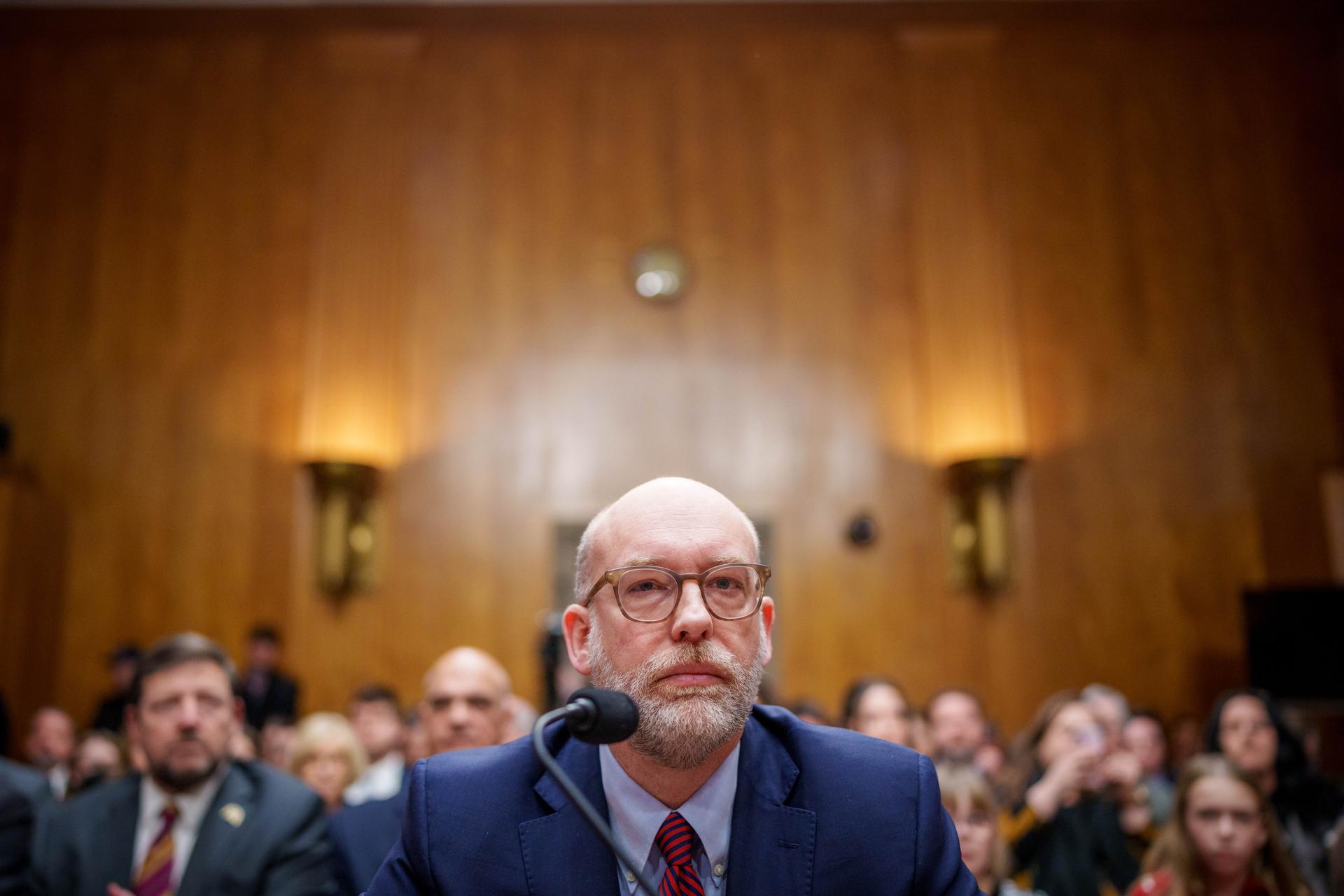
Vought could not have been clearer that this was not the case, and he had the credentials that should have made what he was saying entirely credible. After all, Vought was the author of the plan in Trump’s first term to make it easier to fire large numbers of civil servants. He was a key member of Project 2025, the Heritage Foundation project that described in copious detail how a second Trump administration might unfold.
Still, there was at least one data point that perhaps prevented readers from viewing his speeches as predictive as they turned out to be. As our story made clear, Vought despises the Federalist Society for Law and Public Policy Studies, a core Republican ally in bringing conservative voices into the judiciary and federal law enforcement. We quoted him as asserting that “the vaunted so-called Federalist Society and originalist judges” were serving as a “Praetorian Guard” for the Democrats.
That view would seem to make him something of a fringe thinker in MAGA world, which relied on the Federalist Society to pick the judges who make up the conservative supermajority on the high court.
Things look different today. Seen against the backdrop of recent events, Vought’s disdain for the rule-of-law scruples of Federalist Society legal thinkers seems entirely in line with Trump’s recent post suggesting a federal judge shouldn’t have authority over his administration.
Just a few weeks ago, Danielle Sassoon, one of the Federalist Society’s bright lights, a Yale Law graduate who had clerked for conservative icon Antonin Scalia, resigned as acting U.S. attorney in the Southern District of New York rather than carry out orders from the Trump Justice Department. In refusing to drop the corruption case against New York Mayor Eric Adams, Sassoon wrote that she understood her duty as a prosecutor to mean “enforcing the law impartially, and that includes prosecuting a validly returned indictment regardless of whether its dismissal would be politically advantageous, to the defendant or those that appointed me.”
Many years ago, a New York Times investigative reporter and I were discussing a story we had worked on that had been sharply and justifiably criticized as new facts emerged. “I can be fair and accurate,” he said. “But fair, accurate and prescient is beyond me.”
It seems appropriate to give Vought the last word since the worldview he described has proven so accurate. What sounded grandiose in the preelection days seems today like a reasonable summary of the path Trump and his allies have chosen.
“We are here in the year of 2024, a year that very well [could] — and I believe it will — rival 1776 and 1860 for the complexity and the uncertainty of the forces arrayed against us,” Vought said, citing the years when the colonies declared independence from Britain and the first state seceded over President Abraham Lincoln’s election.
“God put us here for such a time as this.”
I’m not sure about the role of the almighty in ProPublica’s work in the coming years. But we feel equally strongly that we’re here for a “time such as this.”